What Happens After You Reach Your Breaking Point in a Relationship?

There is a moment when something inside you finally says, I can’t keep doing this.
Maybe it happens after one more argument that leaves you shaking.
Maybe it happens after another apology that changes nothing.
Maybe it happens quietly, while you’re sitting alone, realizing how exhausted you’ve become.
Your breaking point may not look dramatic from the outside.
There may be no slammed door.
No final speech.
No clear plan.
Sometimes the breaking point is simply the moment you stop being able to convince yourself that things are fine.
You may not know what comes next. You may not feel strong. You may not even feel clear.
But something has shifted.
And that shift matters.
The Breaking Point Is Not Always the End
Many people assume that reaching a breaking point means they should immediately know what to do next.
Leave.
Stay.
Set a boundary.
Have a conversation.
Make a plan.
Cut contact.
Start over.
But real life is often more complicated than that.
A breaking point is not always the end of a relationship. Sometimes it is the beginning of clarity. It is the moment when your body, mind, and spirit can no longer carry the emotional weight in the same way.
It may be the first time you fully admit:
This is hurting me.
This is costing me.
I cannot keep abandoning myself to keep this relationship going.
That awareness can be powerful.
It can also be overwhelming.

You May Feel Relief and Grief at the Same Time
One of the most confusing things after reaching your breaking point is that your emotions may not make sense at first.
You may feel relief because you finally named what has been happening.
You may feel grief because naming it makes it harder to ignore.
You may feel anger at the other person.
You may feel anger at yourself for staying as long as you did.
You may feel fear about what comes next.
You may feel guilt for even thinking about change.
All of these feelings can exist together.
Reaching your breaking point does not mean you suddenly stop caring. It does not mean you no longer feel attached. It does not mean every part of you is ready.
It simply means the part of you that has been trying to survive is tired.
And it deserves to be listened to.
The Emotional Crash After “Enough Is Enough”
Sometimes, after a breaking point, people expect to feel empowered.
And sometimes they do.
But often, there is an emotional crash.
Your body may feel exhausted. You may want to sleep more. You may feel foggy, numb, or emotionally raw. You may find yourself crying over small things or feeling strangely disconnected from everything.
This can happen because you have been operating in survival mode for a long time.
When you finally admit how much something has been affecting you, your nervous system may begin to release what it has been holding.
You are not falling apart.
You may be feeling the weight of what you have carried.
That can be painful. But it can also be the beginning of coming back to yourself.

You May Start Replaying Everything
After a breaking point, your mind may try to make sense of what happened.
You may replay conversations.
You may review old text messages.
You may remember moments you dismissed at the time.
You may start connecting dots you were not ready to see before.
This can bring clarity, but it can also become overwhelming.
You might find yourself asking:
Was it really that bad?
Did I overreact?
Why didn’t I see it sooner?
How did I let it get this far?
Try to be gentle with yourself here.
When you are inside a painful relationship dynamic, you are not seeing it from a distance. You are trying to survive it in real time.
You made sense of things the best you could with the information, capacity, and support you had at the time.
That does not make you foolish.
It makes you human.
Guilt May Show Up Quickly
Guilt is very common after reaching a breaking point, especially if you have spent years people-pleasing, over-functioning, or feeling responsible for someone else’s emotions.
You may think:
What if I’m being unfair?
What if they really do need me?
What if I’m giving up too soon?
What if this hurts them?
But guilt does not always mean you are doing something wrong.
Sometimes guilt shows up when you are doing something unfamiliar.
If you have spent a long time prioritizing someone else’s comfort over your own well-being, choosing yourself may feel wrong at first.
That does not mean it is wrong.
It may simply mean you are stepping out of an old role.
You May Feel Pressure to Make a Decision Immediately
Once you reach your breaking point, you may feel like you need to act quickly.
Sometimes immediate action is necessary, especially if there is danger, intimidation, threats, or escalating abuse. In those situations, safety matters first, and it is important to reach out for support from trusted people or appropriate crisis resources.
But in many situations, the first step after a breaking point is not a dramatic decision.
The first step is grounding.
Before you make big choices, give yourself permission to slow down and ask:
What do I know right now?
What do I need today?
What feels unsafe, unhealthy, or unsustainable?
Who can I talk to who will not pressure or shame me?
What is one small step that protects my emotional well-being?
A breaking point can bring urgency, but healing often requires steadiness.
You do not have to solve your entire life in one moment.

You May Begin Seeing the Pattern More Clearly
Once you stop minimizing what has been happening, you may begin to notice the pattern underneath the individual events.
It may not be about one argument.
It may be about a cycle.
A cycle of being dismissed.
A cycle of trying harder.
A cycle of being blamed.
A cycle of forgiving without repair.
A cycle of losing yourself to keep the peace.
This is often the point when people begin to understand that the relationship has not just been difficult.
It has been draining them.
The breaking point can become the moment when scattered painful experiences begin to form a clearer picture.
That clarity can hurt.
But it can also help you stop explaining away what is harming you.
The Part of You That Hopes May Still Be There
Even after you reach your breaking point, hope may not disappear.
You may still hope they will understand.
You may still hope they will change.
You may still hope the good parts can come back and stay.
You may still hope there is a way to fix it without losing the relationship.
This does not mean you are weak.
It means you are attached. It means you cared. It means there were parts of the relationship that mattered to you.
The presence of hope does not automatically mean the relationship is healthy.
And the presence of pain does not mean the good moments were fake.
Both can be true.
The important question becomes:
What is this relationship consistently costing me?
Not just in isolated moments, but over time.
What Not to Do After a Breaking Point
After reaching your breaking point, try not to rush into self-judgment.
Try not to shame yourself for not knowing what to do.
Try not to demand immediate certainty from a nervous system that has been under stress.
And try not to confuse the intensity of the moment with the full picture of your needs.
Instead, start with observation.
Notice what your body is telling you.
Notice what patterns keep repeating.
Notice where you feel relief.
Notice where you feel fear.
Notice what becomes clearer when you are not trying to manage someone else’s reaction.
You are allowed to gather information before you decide what comes next.
What You Can Do Instead
If you have reached your breaking point, begin with small, stabilizing steps.
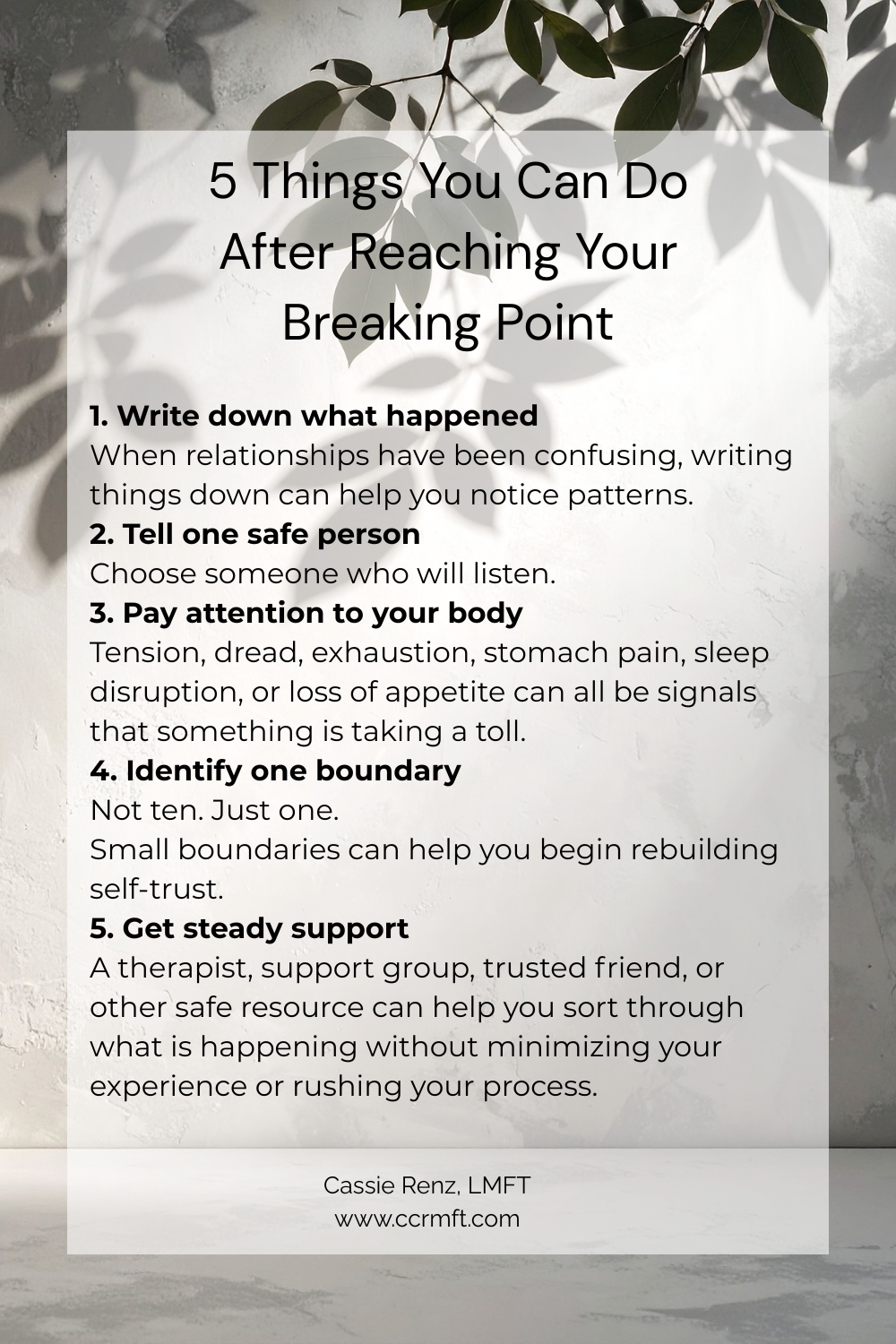
1. Write down what happened
Not to build a case against anyone, but to help yourself stay connected to your own reality.
When relationships have been confusing or emotionally draining, writing things down can help you notice patterns more clearly.
2. Tell one safe person
Choose someone who can listen without immediately telling you what to do.
You need support, not pressure.
3. Pay attention to your body
Your body may have been speaking long before your mind could form the words.
Tension, dread, exhaustion, stomach pain, sleep disruption, or loss of appetite can all be signals that something is taking a toll.
4. Identify one boundary
Not ten. Not your whole future.
Just one.
Maybe it is not responding to texts immediately.
Maybe it is taking space after conflict.
Maybe it is saying, “I’m not ready to talk about this right now.”
Maybe it is choosing not to explain yourself repeatedly.
Small boundaries can help you begin rebuilding self-trust.
5. Get steady support
A therapist, support group, trusted friend, or other safe resource can help you sort through what is happening without minimizing your experience or rushing your process.
You do not have to carry the full weight of this alone.
Your Breaking Point May Be Asking You to Come Back to Yourself
Sometimes the breaking point is not only about the relationship.
Sometimes it is about the relationship you have with yourself.
It may be asking:
How long will I keep ignoring what I feel?
How long will I keep shrinking to make this work?
How long will I keep calling this love when it feels like survival?
These are not easy questions.
But they are honest ones.
And honesty is often where healing begins.
Your breaking point may be the moment you stop abandoning yourself.
Not perfectly.
Not all at once.
But enough to begin listening.

You Don’t Have to Know Everything Yet
If you are in the aftermath of a breaking point, you may want a clear answer right now.
But sometimes the answer comes slowly.
First comes the recognition.
Then the grief.
Then the clarity.
Then the courage to take the next step.
You do not have to know the whole path before you begin.
You only need to notice that something in you is asking for care, honesty, and change.
That is enough for today.
Final Thoughts
Reaching your breaking point in a relationship can feel frightening, disorienting, and painful.
But it can also be a turning point.
Not because everything becomes clear immediately.
But because you can no longer unknow what you know.
You can no longer pretend the cost is not real.
You can no longer keep abandoning yourself without feeling the impact.
And while that realization may hurt, it can also become the beginning of something deeply important:
A return to your own voice.
Your own needs.
Your own reality.
Your own life.
You are allowed to listen to the part of you that says, enough.
You are allowed to move slowly.
You are allowed to seek support.
And you are allowed to begin choosing yourself, one grounded step at a time.
If you are navigating the aftermath of a breaking point in an emotionally draining or toxic relationship, therapy can offer a steady space to sort through what you are feeling, rebuild self-trust, and begin finding your way back to yourself.