Gaslighting: What It Is, 8 Warning Signs, and How to Protect Yourself
Gaslighting is a form of psychological and emotional manipulation that can slowly erode a person’s confidence, sense of reality, and trust in themselves.
Over the last decade, the word gaslighting has become widely used in conversations about relationships and mental health. But despite its growing popularity, many people still struggle to clearly understand what gaslighting actually looks like in real life.
Gaslighting can deeply impact your confidence and emotional clarity. If you’ve been experiencing this dynamic in a relationship, learning to recognize the signs of emotionally draining relationships can be an important first step toward change.

One of the reasons gaslighting is so difficult to identify is that it rarely starts in obvious ways. Instead, it often begins with subtle dismissals, small denials, or confusing conversations that leave you questioning your own perception.
Over time, those small moments can accumulate into something much more damaging.
People who experience gaslighting often describe feeling:
Constantly confused after conversations
Unsure whether their memory is accurate
Responsible for another person’s emotions
Anxious about bringing up concerns
Increasingly disconnected from their own instincts
Gaslighting can occur in romantic relationships, families, friendships, and even workplaces. Wherever there is a power imbalance or emotional control, gaslighting behaviors may appear.
In this guide, we will explore:
What gaslighting actually is
The most common gaslighting tactics
Why people use gaslighting
The emotional impact of gaslighting
How to recognize the warning signs
Steps you can take to protect yourself and rebuild trust in your own perception
Understanding gaslighting is often the first step toward reclaiming your clarity, confidence, and emotional autonomy.
If you’re currently navigating a confusing or emotionally draining relationship, working with a therapist can help you rebuild trust in your own perceptions and emotional clarity. You can learn more about my relationship counseling services here.
Quick Answer: What Is Gaslighting?
Gaslighting is a form of psychological manipulation where one person attempts to make another person doubt their memory, perception, or reality.
Common signs of gaslighting include:
Denying things that clearly happened
Telling you that you are “too sensitive” or “overreacting”
Rewriting past events
Blaming you for their behavior
Making you question your own memory or judgment
Over time, gaslighting can cause self-doubt, confusion, anxiety, and loss of confidence.

What Is Gaslighting?
Gaslighting is a form of emotional manipulation in which one person attempts to make another person doubt their perception of reality, memory, or emotional experiences.
The goal of gaslighting, whether conscious or unconscious, is often control.
Instead of openly addressing conflicts or taking responsibility for their behavior, a gaslighter manipulates conversations in ways that cause the other person to question themselves.
Common messages communicated through gaslighting include:
“That never happened.”
“You’re imagining things.”
“You’re remembering it wrong.”
“You’re overreacting.”
“You’re too sensitive.”
Over time, hearing these messages repeatedly can make someone feel uncertain about their own thoughts and emotions.
Eventually, the person experiencing gaslighting may begin relying on the gaslighter’s interpretation of reality instead of trusting themselves.
Where the Term Gaslighting Comes From
The term gaslighting comes from the 1938 play Gas Light and its 1944 film adaptation Gaslight.
In the story, a husband manipulates his wife into believing she is losing her sanity. One of his tactics involves secretly dimming the gas lights in their home while insisting the lights have not changed at all.
When the wife notices the lights flickering and questions him, he repeatedly denies it.
Over time, his constant denial causes her to question her own perception.
While modern gaslighting rarely involves literal lamps, the psychological mechanism remains the same: repeatedly denying someone’s reality until they begin doubting themselves.
Gaslighting vs. Normal Disagreement
Not every disagreement or misunderstanding is gaslighting.
Healthy relationships include differences in perspective. People sometimes remember events differently or interpret situations in different ways.
Gaslighting becomes a problem when there is a pattern of manipulation designed to undermine someone’s sense of reality.
Signs that behavior may be gaslighting rather than normal disagreement include:
Persistent denial of events that clearly occurred
Repeatedly dismissing emotional responses
Blaming the other person for bringing up concerns
Rewriting past events to avoid accountability
Creating ongoing confusion about what is real
The key distinction is pattern and impact.
If someone consistently leaves you feeling confused, self-doubting, or emotionally destabilized, gaslighting may be present.
8 Common Gaslighting Tactics
Gaslighting rarely appears all at once. It typically unfolds through repeated behaviors that gradually undermine a person’s confidence.
Here are some of the most common gaslighting tactics.
Denial of Reality
A gaslighter may deny events that clearly occurred.
Examples include:
“I never said that.”
“That never happened.”
“You’re remembering it wrong.”
Repeated denial creates self-doubt.
Minimizing Your Feelings
Your emotional reactions are dismissed or trivialized.
Examples:
“You’re too sensitive.”
“You’re overreacting.”
“You’re being dramatic.”
Over time, this teaches you to distrust your own emotions.
Countering
Countering involves questioning your memory or interpretation.
Examples:
“Are you sure?”
“That’s not how it happened.”
“You always get things mixed up.”
This tactic gradually erodes confidence in your perception.
Deflecting and Blaming
Instead of addressing your concerns, the gaslighter redirects the conversation toward your supposed flaws.
Example:
You say:
“It hurt me when you canceled our plans.”
They respond:
“Well maybe if you weren’t so needy…”
Withholding
The gaslighter may refuse to engage in conversations about important issues.
Examples include:
The silent treatment
Pretending not to understand
Saying “I’m not discussing this”
This shifts attention away from their behavior.
Rewriting the Past
Gaslighters frequently reshape past events to avoid responsibility.
Examples:
“I never agreed to that.”
“You misunderstood.”
“I already told you that.”
Love-Bombing and Devaluation
In romantic relationships, gaslighting often appears alongside cycles of intense affection followed by criticism or withdrawal.
This pattern creates emotional confusion and dependence.
Triangulation
Triangulation involves bringing other people into the situation to undermine your perception.
Examples:
“Everyone agrees with me.”
“My friends think you’re overreacting.”
Emotional Effects of Gaslighting
Gaslighting can have profound psychological consequences.
Over time, people who experience gaslighting often report:
Chronic Self-Doubt
You begin questioning your memory, emotions, and instincts.
Anxiety and Hypervigilance
You may constantly anticipate conflict or prepare for emotional invalidation.
Mental Fog
The confusion created by gaslighting can make it difficult to think clearly.
Loss of Confidence
Repeated invalidation can erode self-trust.
Isolation
Gaslighting often creates distance between you and supportive people in your life.
Emotional Dependence
When you no longer trust yourself, you may rely on the gaslighter’s version of reality.
10 Signs You May Be Experiencing Gaslighting
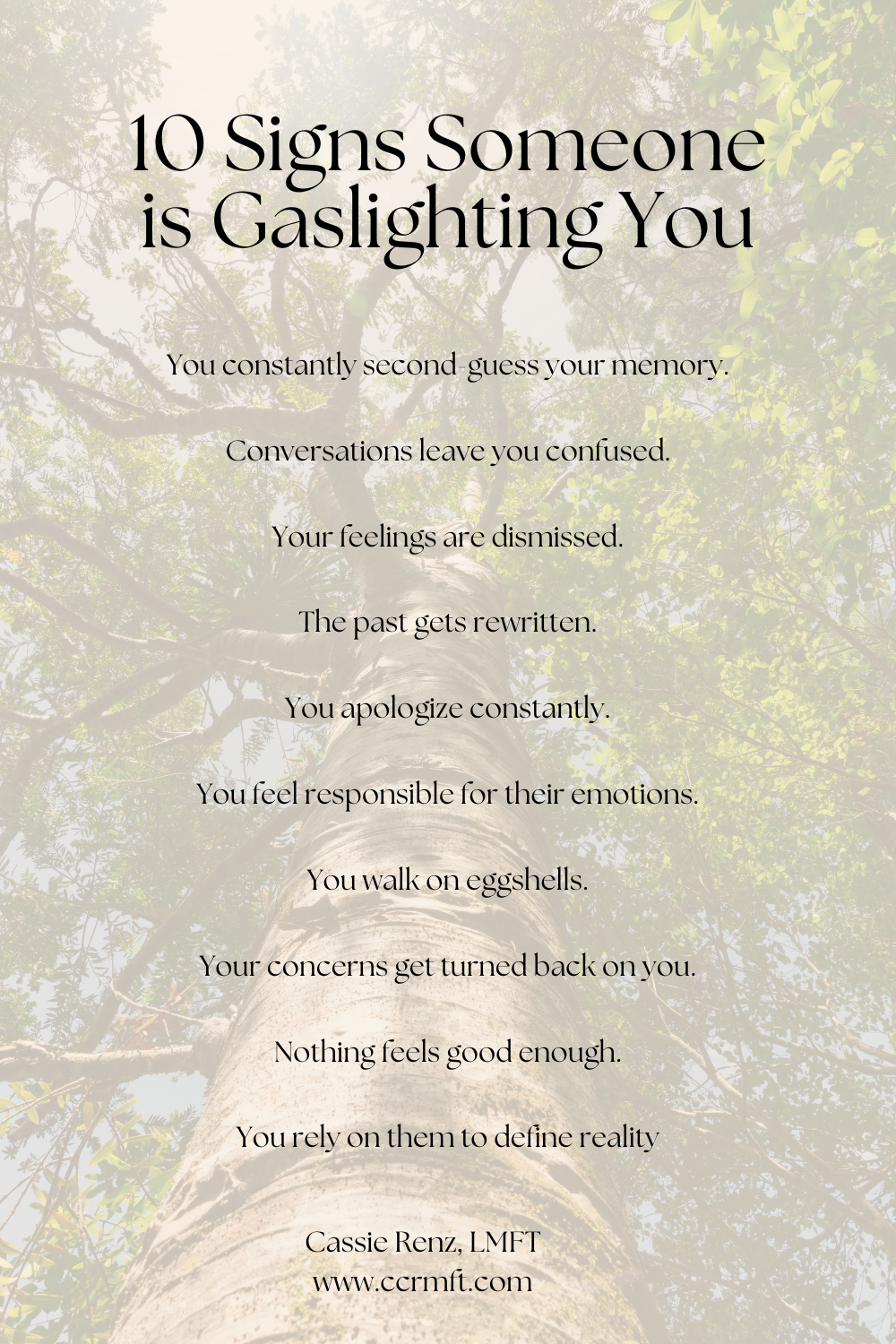
Gaslighting can be difficult to recognize while it’s happening.
However, several patterns often appear.
You may be experiencing gaslighting if:
You constantly second-guess your memory
You apologize even when you're not sure what you did wrong
Conversations leave you feeling confused
Your feelings are dismissed as “too sensitive”
The past gets rewritten during arguments
You feel responsible for their emotions
You feel like you're walking on eggshells
Your concerns are turned back on you
Nothing you do feels “good enough”
You begin relying on them to define reality
If any of these experiences resonate, it may be helpful to examine the relationship dynamics more closely.
If gaslighting has affected your self-confidence or emotional well-being, you may find it helpful to explore strategies for rebuilding emotional clarity and healthy boundaries.

How to Respond to Gaslighting
It is rarely possible to convince someone to stop gaslighting through logic alone.
However, there are steps you can take to protect your emotional well-being.
Name the Behavior
Recognizing gaslighting for what it is can break the confusion it creates.
Document Conversations
Keeping notes or written records can help maintain clarity.
Seek Outside Perspective
Talking with a trusted friend or therapist can provide validation.
Set Boundaries
Examples include:
“I’m not continuing this conversation if my feelings are dismissed.”
Consider Limiting Contact
If the behavior continues, distance may be necessary for your well-being.
Learning to set boundaries and reconnect with your intuition is an important part of healing. If you'd like deeper guidance, you may find this resource helpful.
Healing After Gaslighting
Recovering from gaslighting involves rebuilding trust in yourself.
This process may include:
Validating your emotions
Reconnecting with your intuition
Seeking therapeutic support
Surrounding yourself with emotionally safe people
Practicing self-compassion
Healing takes time, but it is absolutely possible.
Frequently Asked Questions About Gaslighting
-
Gaslighting is a form of emotional manipulation where someone causes another person to doubt their perception, memory, or reality.
-
Not always. Some people gaslight intentionally to gain control, while others repeat learned behaviors without recognizing their impact.
-
Common gaslighting phrases include:
“That never happened.”
“You’re too sensitive.”
“You’re imagining things.”
-
Yes. Gaslighting can occur in families, romantic relationships, friendships, and workplaces.